
5 Signs Your Advertising Budget Is Being Wasted
5 Signs Your Advertising Budget Is Being Wasted
We’ve met businesses with modest marketing budgets that consistently outperform their competitors. We’ve also met companies spending significantly more but seeing very little return.
The difference usually isn’t the amount being spent.
It’s how that budget is planned.
At JEV Integrated, we’ve found that businesses rarely waste money because they choose the “wrong” advertising platform. More often, they waste money because every marketing decision is made independently instead of contributing to one clear objective.
If you’re wondering whether your advertising budget is working as hard as it should, here are five signs worth paying attention to.
1. Every campaign feels disconnected
Your billboard says one thing.
Your social media says something else.
Your digital advertisements use different visuals, while your website tells another story.
When every platform communicates differently, customers receive mixed messages. Instead of strengthening your brand, each campaign competes for attention.
This is why we always look at campaigns as a whole, ensuring every advertising channel supports the same message rather than operating in isolation.
2. You’re choosing media before defining the objective
One of the biggest mistakes businesses make is deciding on the platform first.
“Let’s book a billboard.”
“Let’s boost Facebook posts.”
“Let’s try radio.”
The better question is, what are you trying to achieve?
Once the objective is clear, choosing the right media becomes much easier.
3. You’re measuring every platform separately
It’s natural to ask whether a billboard generated enquiries or whether social media produced more clicks.
The challenge is that customers don’t experience your marketing one platform at a time.
Someone might notice your billboard today, search your business tomorrow and make an enquiry after seeing your digital advertisement a week later. Every touchpoint plays a role, even if it isn’t the final one before the customer takes action.
That’s why we encourage businesses to look at the customer journey instead of judging every advertising channel on its own.
4. You’re changing direction too quickly
We’ve seen businesses replace creatives, switch platforms or stop campaigns after only a short period because they expected immediate results.
While some campaigns deliver quick responses, others are designed to build awareness over time. Brand recognition doesn’t happen overnight, and constantly changing direction often resets the progress you’ve already made.
Consistency is often more valuable than constantly chasing the next marketing trend.
5. Your advertising isn’t backed by a strategy
This is probably the biggest warning sign of all.
If every campaign begins with “Where should we advertise?” instead of “What business problem are we trying to solve?”, there’s a good chance the budget isn’t being used as effectively as it could be.
At JEV Integrated, strategy always comes first. Before recommending outdoor advertising, digital marketing, radio, cinema or any other channel, we take the time to understand the business, the audience and the desired outcome. That planning helps ensure every Ringgit is working towards the same objective instead of being spread across disconnected activities.
The biggest advertising budget doesn’t always produce the biggest results. The best strategy usually does.
If any of these signs sound familiar, it doesn’t necessarily mean you’ve been making poor marketing decisions. It may simply mean your advertising needs a clearer direction. Once every campaign starts working together instead of separately, your budget has a much better chance of delivering the results your business is looking for.
Frequently Asked Question
What is the minimum duration for a billboard campaign in Malaysia?
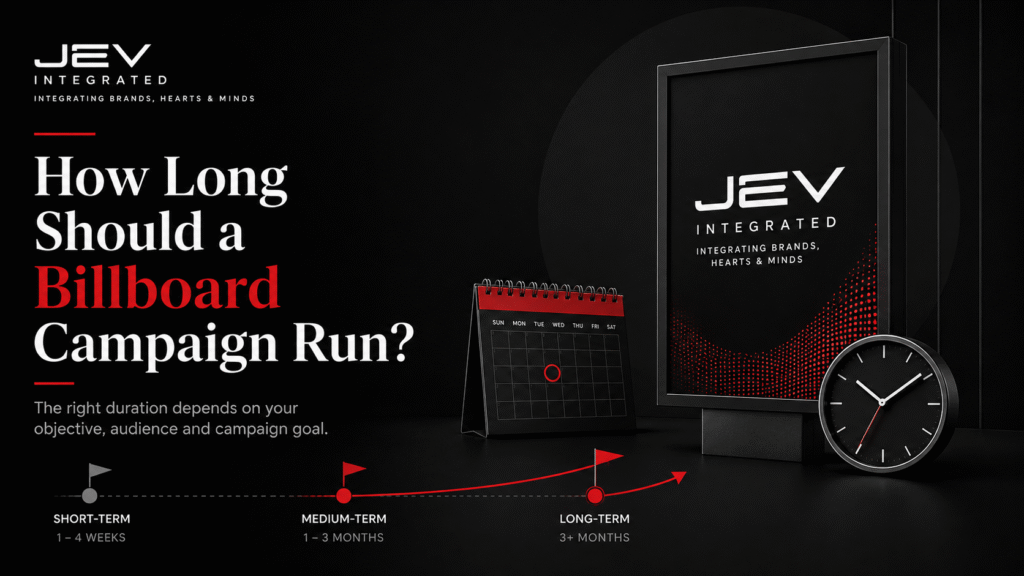
The standard minimum booking cycle for static billboards in Malaysia is 4 weeks (1 month). However, Digital Out-Of-Home (DOOH) screens allow shorter, highly targeted runs ranging from a few days to 2 weeks for flash events and time-sensitive launches.
Why is 3 months (12 weeks) recommended for most outdoor ad campaigns?
A 12-week campaign strikes an optimal balance between audience reach and brand recall. It provides sufficient frequency for daily commuters to transition from initial brand awareness to consideration and online search behavior.
How often should you change billboard artwork during a long campaign?
For long-term campaigns lasting 6 to 12 months, refreshing artwork every 2 to 3 months prevents ad fatigue while maintaining prime site presence along key commuting routes.