
More Ads Won’t Help If Your Brand Keeps Changing
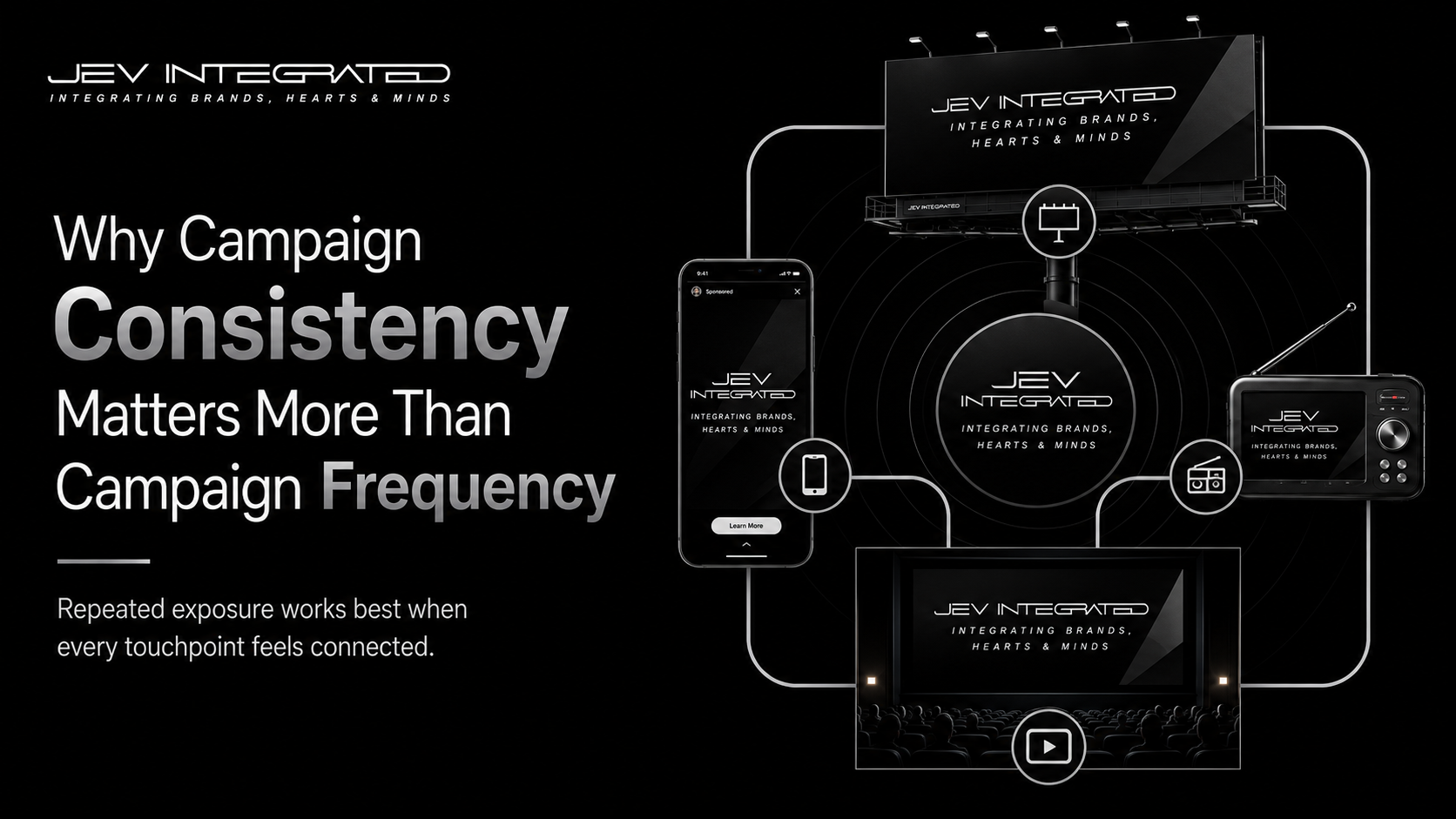
Why Campaign Consistency Matters More Than Campaign Frequency
A business runs a billboard campaign this month. Next month, the social media team introduces a completely different visual style. A few weeks later, another promotion launches with a new message, while the digital advertisements look like they came from another brand entirely. Technically, the business is advertising frequently. The problem is that customers may not realise they’re seeing the same business.
This is where campaign consistency becomes just as important as exposure. Advertising frequency helps people encounter your brand repeatedly, but consistency helps them connect those encounters. If the message, visual identity and overall campaign direction keep changing, every new advertisement has to work harder to rebuild recognition.
Think about brands you can recognise before even seeing their name. It might be the colours, typography, tone of voice, visual style or simply the way they communicate. That recognition didn’t happen because you saw one great advertisement. It happened because repeated exposure kept reinforcing something familiar.
For businesses running campaigns across several channels, maintaining that familiarity can become difficult. A billboard has very different requirements from a social media video. A radio advertisement can’t rely on visuals at all, while cinema gives creative teams more time to tell a story. The solution isn’t to make every advertisement identical. It’s to make every advertisement feel connected.
Consistency Doesn’t Mean Copy and Paste
This is an important distinction we make when planning campaigns at JEV Integrated. An outdoor advertisement designed for motorists shouldn’t simply be resized and placed on social media. Likewise, a 30-second video isn’t automatically suitable for a digital billboard just because both use screens.
Instead, we identify the central campaign idea first and then adapt it to suit each medium. The message, visual identity and brand direction remain recognisable, while the execution changes according to how people consume that particular media.
For example, the OOH creative might introduce one strong headline and visual. Digital content can then expand on that message with more information. Radio could reinforce the campaign through sound and repetition, while cinema gives the brand more room for storytelling. The audience experiences different executions, but every interaction still strengthens the same idea.
When More Advertising Becomes More Noise
This is where increasing frequency alone can become expensive.
If a business keeps running advertisements but changes its message too frequently, people may see the brand many times without building meaningful recognition. Increasing the budget might generate more impressions, but it doesn’t necessarily fix the underlying problem.
At JEV Integrated, this is one of the reasons we look at the wider campaign before recommending additional media. If the issue is weak consistency, buying another billboard or increasing digital spend may not be the first solution. We may need to strengthen the campaign direction so the media already being used can work harder together.
That could mean aligning the creative across OOH and digital, refining the key message, coordinating campaign timing or deciding which media should introduce the idea and which should reinforce it. Our capabilities across media planning and buying, OOH, DOOH, digital, radio, television, cinema and creative production allow us to manage those connections instead of treating each placement as a separate advertisement.
Consistency Makes Every Exposure More Valuable
Imagine someone notices your billboard during their commute. Later that day, they encounter your digital advertisement and immediately recognise the visual. A few days later, they hear the campaign on the radio and recognise the message again. Each exposure doesn’t start from zero; it builds on something the audience has already encountered.
That’s where frequency becomes much more powerful.
The question businesses should ask isn’t simply, “How many times will people see our advertisement?” It should also be, “Will they know it’s us every time they see it?”
Advertising frequency creates opportunities to be noticed. Campaign consistency turns those opportunities into recognition. When JEV Integrated brings the strategy, creative and media together under one clear direction, each channel can do its own job while still contributing to the same brand memory.
For businesses trying to stay top of mind, that’s ultimately what matters. Being seen more often helps, but being recognised every time is what makes those exposures count.
Frequently Asked Question
What is the minimum duration for a billboard campaign in Malaysia?
The standard minimum booking cycle for static billboards in Malaysia is 4 weeks (1 month). However, Digital Out-Of-Home (DOOH) screens allow shorter, highly targeted runs ranging from a few days to 2 weeks for flash events and time-sensitive launches.
Why is 3 months (12 weeks) recommended for most outdoor ad campaigns?
A 12-week campaign strikes an optimal balance between audience reach and brand recall. It provides sufficient frequency for daily commuters to transition from initial brand awareness to consideration and online search behavior.
How often should you change billboard artwork during a long campaign?
For long-term campaigns lasting 6 to 12 months, refreshing artwork every 2 to 3 months prevents ad fatigue while maintaining prime site presence along key commuting routes.