
Planning an Ad Campaign? Avoid These Mistakes Before You Spend
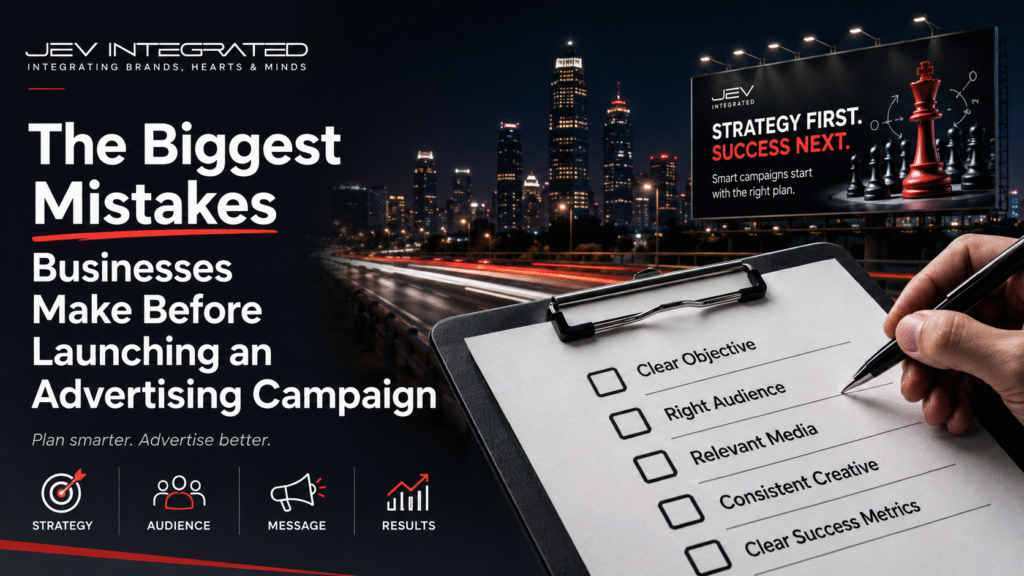
The Biggest Mistakes Businesses Make Before Launching an Advertising Campaign
By the time an advertising campaign goes live, some of its biggest problems may already be impossible to fix. The billboard has been booked, artwork has been approved, digital media is scheduled and the budget has been committed. If the strategy wasn’t clear from the beginning, changing direction now can become expensive.
That’s why at JEV Integrated, we pay close attention to what happens before the public sees anything. Good execution matters, but even excellent execution can’t completely rescue a campaign built on the wrong objective, audience or media decision.
Here are five mistakes worth catching while there’s still time to do something about them.
1. Starting With the Media Instead of the Problem
“We need a billboard” sounds like a clear brief, but it doesn’t tell us what the business actually needs.
Why a billboard? Are you trying to introduce a new product, generate awareness for a property launch, increase store visits or make an established brand more visible? Those objectives could lead to completely different recommendations.
At JEV Integrated, we prefer to understand the business problem before discussing the media. Sometimes a billboard is exactly what the campaign needs. Other times, DOOH, digital, radio, cinema or a combination of channels may solve the problem more effectively. Starting with the objective gives us room to recommend what makes sense instead of forcing the campaign around a decision that’s already been made.
2. Trying to Reach Everyone
A campaign designed for “everyone” usually becomes difficult to plan because there is no clear answer to where, when or how the brand should appear.
Consider two property campaigns. One targets young first-time homebuyers while another promotes premium residences to higher-income buyers. Both sell property, but the audience journey, media locations and creative approach could be completely different.
This is why audience understanding affects more than digital targeting. For JEV, it also influences which billboard locations we shortlist, which media channels deserve more budget and how the creative should communicate. Reaching fewer relevant people can be far more valuable than reaching a huge audience with little reason to care.
3. Putting Too Much Into the Advertisement
Businesses naturally want to maximise the space they’ve paid for. That often leads to one headline, several benefits, a promotion, contact details, social handles, a QR code and a long call to action all fighting for attention.
The result may contain everything the business wants to say but nothing the audience can remember.
When JEV handles creative development, we consider where that creative will actually appear. Someone driving past an OOH placement has a different amount of attention from someone watching a cinema advertisement. The creative should respect the medium. Sometimes the strongest improvement we can make is deciding what not to include.
4. Treating Every Advertising Channel as a Separate Campaign
This problem becomes obvious when a business is using several media channels. The billboard communicates one idea, social media uses another visual direction and digital advertising promotes something completely different.
Each team may be doing good work individually, but the audience doesn’t experience your company department by department. They experience one brand.
JEV Integrated can coordinate media planning, buying, creative and execution across OOH, DOOH, digital, television, radio and cinema. That allows us to give different channels different jobs while keeping them connected to the same campaign objective. The executions don’t need to be identical, but they should strengthen one another rather than starting a new conversation every time.
5. Waiting Until the End to Decide What Success Means
A campaign ends and everyone starts asking whether it worked. That’s usually too late to decide how success should be measured.
If the objective was brand awareness, judging the campaign only by direct enquiries may give you the wrong impression. If the objective was lead generation, impressive reach figures alone don’t tell you enough either.
Before launch, JEV works with the campaign objective to determine what signals actually matter. That gives the client a clearer way to evaluate the results and gives our team something useful to learn from when planning the next campaign.
Fix the Strategy While Changes Are Still Cheap
The best time to discover a campaign problem isn’t after the billboard is installed or the media budget has been spent. It’s during planning, when changing the audience, message, location or media mix still costs very little.
This is where JEV Integrated can take pressure off an internal marketing team. Instead of coordinating media owners, creative requirements, placements and different advertising channels separately, businesses can bring us the objective and let our team help connect the strategy, creative, media planning and execution around it.
A successful campaign isn’t simply one that looks good when it launches. It’s one where every important decision already had a reason before the first advertisement ever appeared.
Frequently Asked Question
What is the minimum duration for a billboard campaign in Malaysia?
The standard minimum booking cycle for static billboards in Malaysia is 4 weeks (1 month). However, Digital Out-Of-Home (DOOH) screens allow shorter, highly targeted runs ranging from a few days to 2 weeks for flash events and time-sensitive launches.
Why is 3 months (12 weeks) recommended for most outdoor ad campaigns?
A 12-week campaign strikes an optimal balance between audience reach and brand recall. It provides sufficient frequency for daily commuters to transition from initial brand awareness to consideration and online search behavior.
How often should you change billboard artwork during a long campaign?
For long-term campaigns lasting 6 to 12 months, refreshing artwork every 2 to 3 months prevents ad fatigue while maintaining prime site presence along key commuting routes.