
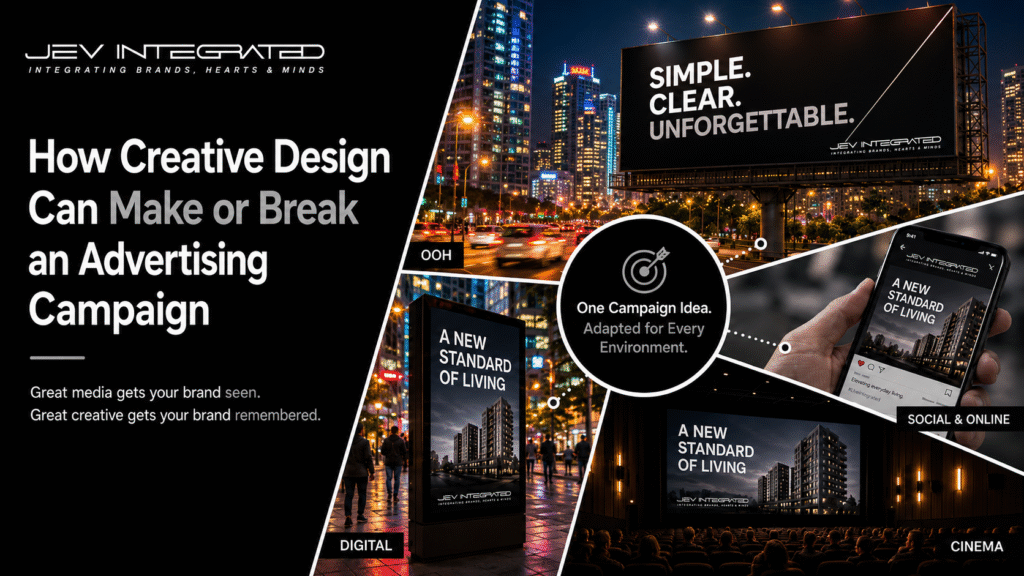
Great Media Placement, Weak Creative? Your Campaign Can Still Fail
How Creative Design Can Make or Break an Advertising Campaign
You secure a premium billboard location. The traffic is strong, the visibility is excellent and the media placement ticks every box. Thousands of people have the opportunity to see your advertisement every day, but there’s one problem: nobody can understand what you’re trying to say before they’ve already driven past it.
That’s a painful way to waste a great media placement.
Creative design in advertising isn’t simply about making something look beautiful. It has a much bigger job: making sure the audience notices the message, understands it quickly and remembers the brand behind it. When that doesn’t happen, even an excellent media plan can lose much of its potential.
A Good Design Still Needs to Work in the Real World
Something can look fantastic on a designer’s monitor and perform poorly once it’s placed on a highway billboard. The reason is simple. People don’t experience advertising inside a presentation deck. They experience it while driving, walking through a shopping centre, scrolling through their phone or waiting for a movie to begin.
Each environment creates different creative requirements.
For a highway billboard, we may only have a few seconds of attention. The message needs to be clear, the visual hierarchy needs to work from a distance and the brand needs to be identifiable quickly. A digital advertisement viewed on a phone can provide more information or invite interaction, while cinema gives us more time to develop a story and emotional connection.
At JEV Integrated, this is why we don’t like separating media planning from creative thinking. Once we understand where the campaign will appear, we can develop or adapt the creative around how people will actually experience it.
Sometimes the Best Creative Decision Is Removing Something
Clients understandably want to communicate as much as possible when they’re paying for advertising space. The product name needs to be there, along with the promotion, benefits, phone number, website, QR code, social media handles and perhaps several supporting messages.
The problem is that the audience doesn’t know where to look first.
This is especially important in OOH and DOOH advertising. If someone has only a few seconds to process the message, adding more information doesn’t necessarily create more value. Sometimes it simply creates more competition inside the advertisement itself.
Our creative team looks at what the audience needs to understand first. Everything else is built around that priority. If the campaign’s purpose is to introduce a new property development, for example, the most important message might be completely different from a retail promotion where price and urgency drive the response.
Creative decisions should follow the campaign objective, not fight against it.
One Campaign Doesn’t Mean One Artwork
This becomes even more important when advertising across multiple channels.
Imagine taking the exact artwork from a static billboard and resizing it for Instagram, then putting the same layout onto a digital screen and expecting it to work equally well everywhere. The branding may be consistent, but the communication isn’t necessarily effective.
JEV Integrated can approach this differently because our work covers both creative and media. We can maintain one campaign idea while adapting its execution for OOH, DOOH, digital, television, radio, cinema or other relevant touchpoints. The audience should recognise the same campaign without feeling like they’re seeing the exact same advertisement copied everywhere.
That’s where creative consistency and media suitability need to work together.
What Happens When Media and Creative Are Planned Together?
Consider a brand launching a new product across Kuala Lumpur. During media planning, we’ve identified a highway billboard, several digital placements and online media that match the target audience.
Instead of designing one advertisement and forcing it onto every platform, JEV can plan how the message develops across those environments. The highway billboard may introduce the product using one strong visual and a short message. DOOH can add movement or alternate creative. Digital advertising can provide more detail and encourage the audience to take action.
The result is still one campaign, but every channel is doing what it does best.
This also helps solve another common marketing problem: businesses paying for excellent media but expecting the media itself to create the impact. A premium location gives your brand an opportunity to be seen. Creative determines what happens during that opportunity.
That’s why JEV Integrated looks at the two together. Our role isn’t simply to secure advertising space or produce attractive artwork. It’s to understand the business objective, select the right media environment and make sure the creative has been designed to perform within it.
The biggest billboard in Malaysia won’t help much if nobody understands the message. The most beautiful advertisement won’t help either if it appears somewhere your audience never sees it.
Great advertising happens when the right message, the right creative and the right media meet the right audience at the same time.
Frequently Asked Question
What is the minimum duration for a billboard campaign in Malaysia?
The standard minimum booking cycle for static billboards in Malaysia is 4 weeks (1 month). However, Digital Out-Of-Home (DOOH) screens allow shorter, highly targeted runs ranging from a few days to 2 weeks for flash events and time-sensitive launches.
Why is 3 months (12 weeks) recommended for most outdoor ad campaigns?
A 12-week campaign strikes an optimal balance between audience reach and brand recall. It provides sufficient frequency for daily commuters to transition from initial brand awareness to consideration and online search behavior.
How often should you change billboard artwork during a long campaign?
For long-term campaigns lasting 6 to 12 months, refreshing artwork every 2 to 3 months prevents ad fatigue while maintaining prime site presence along key commuting routes.