
Big Billboard or Better Location? What Actually Matters More?
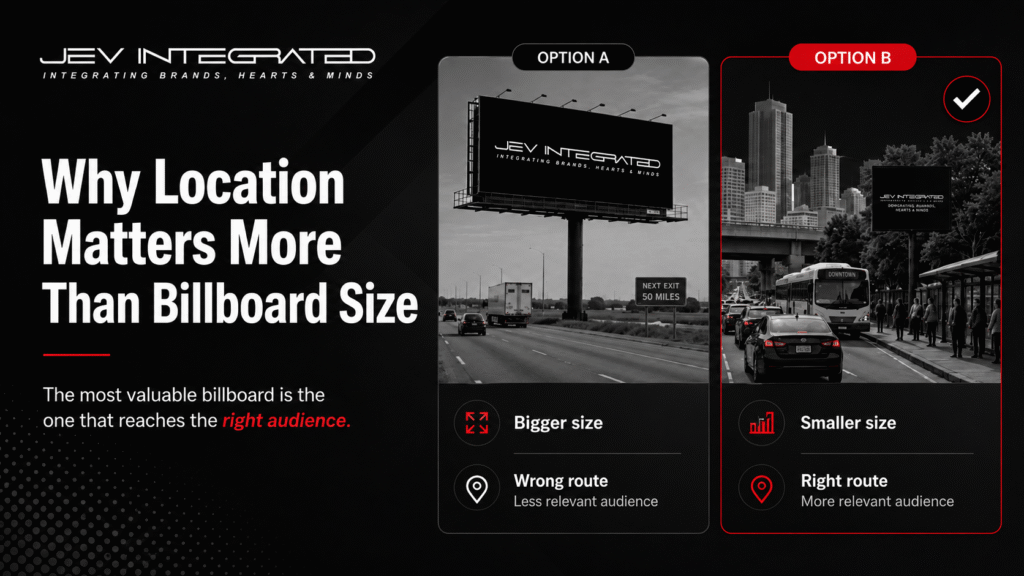
Why Location Matters More Than Billboard Size
Imagine you’re given two billboard options.
Option A: A huge billboard that’s hard to miss, but it’s located on a route your target customers rarely use.
Option B: A smaller billboard positioned directly along the daily journey of the people you’re trying to reach.
Which would you choose?
It’s tempting to pick the bigger one. After all, when you’re paying for outdoor advertising, having more space feels like you’re getting more exposure. But at JEV Integrated, we’d usually want to understand Option B first.
That’s because billboard size only tells us how big the advertisement is. Location tells us who has the opportunity to see it.
A good location isn’t simply a road with heavy traffic either. If we’re evaluating a billboard for a client, we want to understand what surrounds the site, who travels through the area, where the traffic is heading and whether that audience matches the campaign.
Take property advertising. A developer promoting a residential project may benefit from reaching working professionals travelling between particular residential and commercial areas. Put the same advertisement somewhere with significantly higher traffic but the wrong audience, and those extra eyeballs may add very little value.
The same principle applies to retail. If you’re opening a new store, being visible close to the area where people can actually visit may be more useful than having a giant billboard much further away.
This is where JEV Integrated helps clients look beyond a media owner’s rate card. When we’re sourcing or recommending billboard locations, we’re not only comparing dimensions and prices. We look at the site in relation to the client’s objective and consider things such as traffic direction, surrounding developments, audience relevance and how clearly the advertisement can be seen.
Sometimes that means recommending the largest premium site available. Sometimes it means choosing something less obvious because it gives the client a better opportunity to reach the right audience.
There is another factor that can completely change the value of a billboard: how people see it.
A huge billboard doesn’t help much if motorists only notice it at the last second, the viewing angle is poor or the surroundings compete heavily for attention. Meanwhile, a smaller billboard with a clean line of sight and repeated exposure along a daily commute can become incredibly familiar over time.
That’s also why our work doesn’t stop once a location has been selected. The creative has to make sense for that particular site. A message designed for motorists travelling at highway speed should be treated differently from an advertisement positioned near slower-moving urban traffic. The amount of copy, visual hierarchy and call to action all need to work with the environment.
So when clients come to JEV Integrated with several billboard options, our job isn’t simply to tell them which one is biggest. It’s to help them understand which location gives their campaign the strongest reason to be there.
Billboard size absolutely matters, but it should never be judged on its own. Outdoor advertising becomes much more effective when the audience, location, visibility, creative and campaign objective all point in the same direction.
If a smaller billboard consistently puts your brand in front of the people you’re trying to influence, while a larger one simply puts you in front of more people, bigger isn’t necessarily better.
In outdoor advertising, the most valuable space isn’t always the biggest space. It’s the space that puts your business in the right place.
Frequently Asked Question
What is the minimum duration for a billboard campaign in Malaysia?
The standard minimum booking cycle for static billboards in Malaysia is 4 weeks (1 month). However, Digital Out-Of-Home (DOOH) screens allow shorter, highly targeted runs ranging from a few days to 2 weeks for flash events and time-sensitive launches.
Why is 3 months (12 weeks) recommended for most outdoor ad campaigns?
A 12-week campaign strikes an optimal balance between audience reach and brand recall. It provides sufficient frequency for daily commuters to transition from initial brand awareness to consideration and online search behavior.
How often should you change billboard artwork during a long campaign?
For long-term campaigns lasting 6 to 12 months, refreshing artwork every 2 to 3 months prevents ad fatigue while maintaining prime site presence along key commuting routes.