
Is Your Advertising Actually Working? Here’s How to Tell
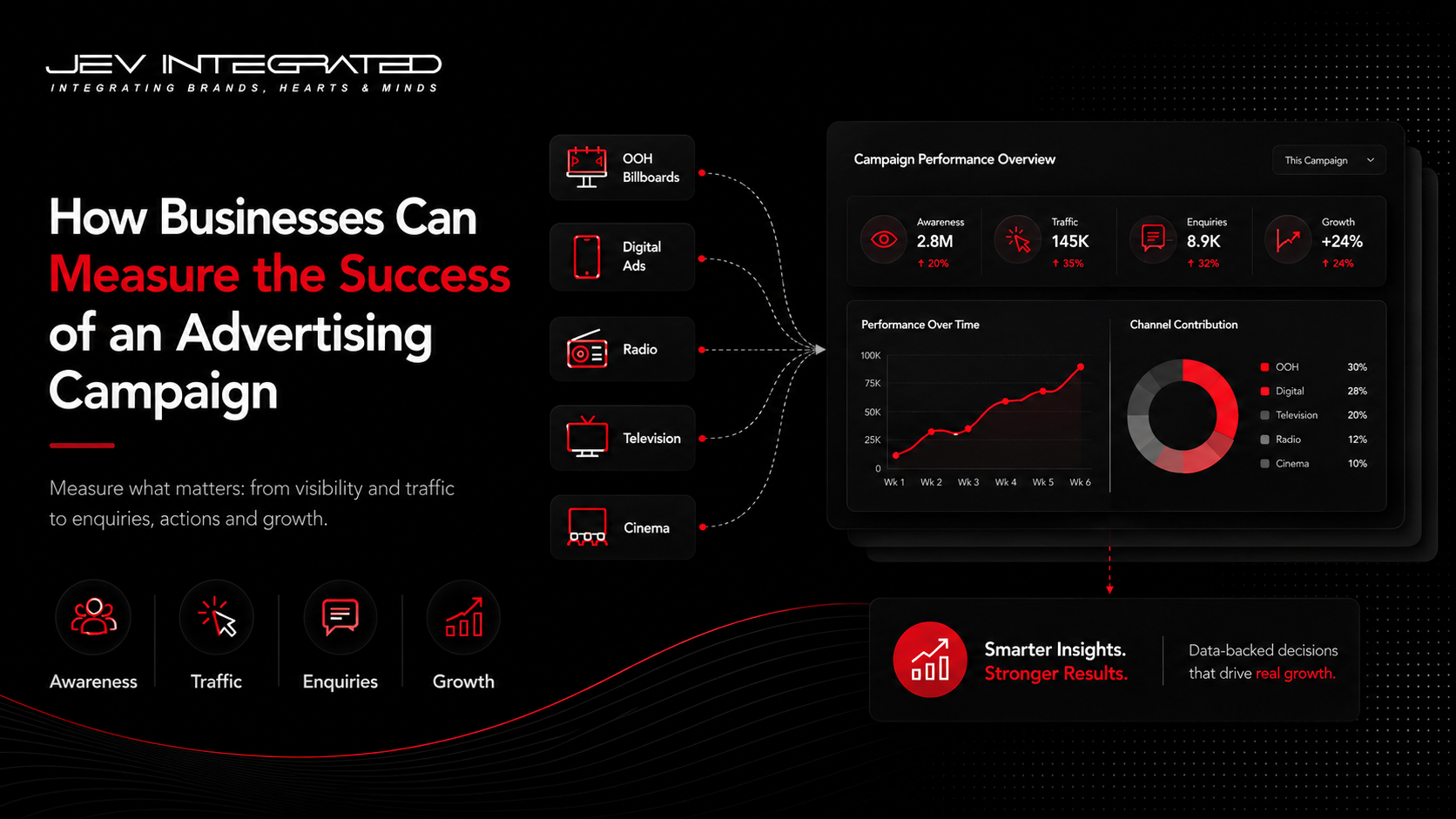
How Businesses Can Measure the Success of an Advertising Campaign
Your campaign just ended and the report looks great: thousands of impressions, plenty of views and maybe some good engagement too. But when someone in the meeting asks, “So, did it actually work?”, suddenly those big numbers don’t seem to answer the question.
That’s because advertising success means different things to different businesses. A property developer looking for enquiries shouldn’t measure success the same way as a company running a nationwide awareness campaign. A retailer trying to bring customers into a new outlet will have another set of priorities altogether. If the objective is different, the measurement should be different too.
This is something we establish early at JEV Integrated. Before deciding which numbers should go into the final report, we first determine what the campaign is expected to achieve. For an awareness campaign, reach, exposure and visibility may matter more. If the goal is generating interest, website activity and enquiries become more useful. For a retail campaign, customer response or store traffic could tell us much more than online engagement alone.
The important part is making sure you’re measuring something that connects back to the original business goal.
Offline advertising makes this particularly interesting. Imagine someone passes your billboard every morning for three weeks. They never scan a QR code or immediately visit your website, but when they finally need your service, they search for your company by name. If you judge that billboard purely by direct responses, you could easily conclude that it didn’t work even though it helped put your brand into that customer’s mind.
This is why JEV looks at the wider campaign rather than forcing every channel to prove itself independently. Depending on the objective, we can look at signals such as:
- Changes in website traffic or branded searches
- Enquiries or customer actions during the campaign period
- Reach and exposure for awareness-focused campaigns
- Performance differences between creatives, media or locations
We don’t need every metric for every campaign. We need the right metrics for that campaign.
The same thinking becomes even more important when several advertising channels are involved. A customer could discover your business from an outdoor advertisement, see it again through digital media and eventually make an enquiry after searching on Google. Asking which single advertisement “caused” the enquiry misses how people actually make decisions. Sometimes the real strength of a campaign comes from those channels reinforcing one another.
For us, measurement also isn’t something that only happens after everything is finished. Campaign results can help identify what’s gaining traction, where the audience is responding and what may need to change. That gives our team something much more useful than a performance report: it gives us information we can use to improve the next decision.
This is where having JEV Integrated involved from planning through execution makes a difference. Because we handle media planning and buying alongside channels such as OOH, DOOH, digital, radio, television and cinema, we can look at how the pieces support the overall objective instead of viewing each placement as a separate purchase. The aim is to help clients understand not only what happened, but also why it matters and what we should do next.
A campaign with millions of impressions can still underperform if those impressions don’t support the business goal. At the same time, a campaign with smaller numbers can be highly valuable if it reaches the right audience and moves them closer to taking action.
So when your next campaign report lands on the table, don’t start by looking for the biggest number. Start with the objective you agreed on before the campaign began. If the results are moving the business towards that objective, you’re measuring something that actually matters.
Frequently Asked Question
What is the minimum duration for a billboard campaign in Malaysia?
The standard minimum booking cycle for static billboards in Malaysia is 4 weeks (1 month). However, Digital Out-Of-Home (DOOH) screens allow shorter, highly targeted runs ranging from a few days to 2 weeks for flash events and time-sensitive launches.
Why is 3 months (12 weeks) recommended for most outdoor ad campaigns?
A 12-week campaign strikes an optimal balance between audience reach and brand recall. It provides sufficient frequency for daily commuters to transition from initial brand awareness to consideration and online search behavior.
How often should you change billboard artwork during a long campaign?
For long-term campaigns lasting 6 to 12 months, refreshing artwork every 2 to 3 months prevents ad fatigue while maintaining prime site presence along key commuting routes.