
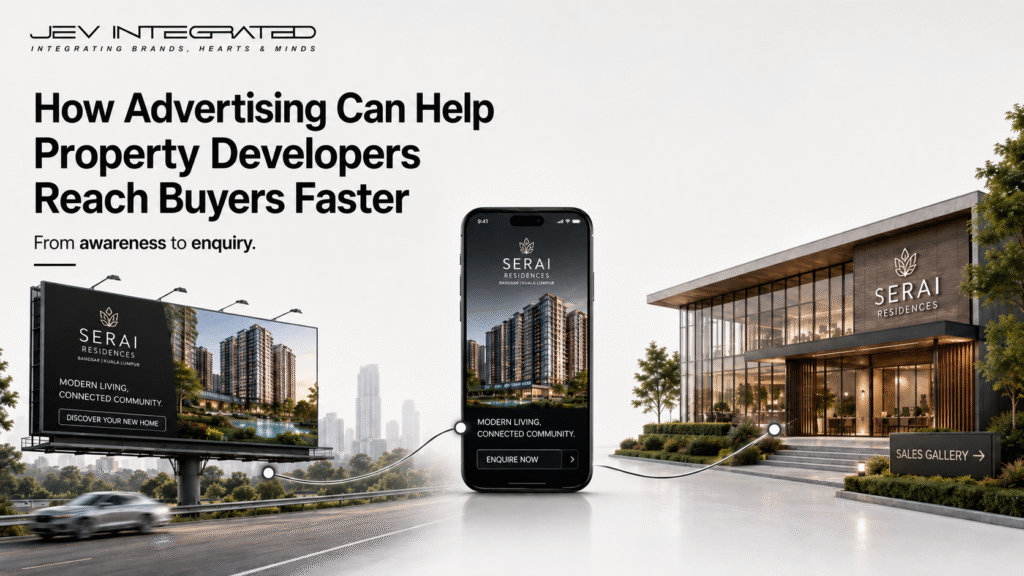
Great Property Project, But Buyers Don’t Know It Exists?
How Advertising Can Help Property Developers Reach Buyers Faster
You can have a great location, attractive facilities, competitive pricing and a beautifully designed show unit, but there’s still one problem every property developer needs to solve: potential buyers need to know the project exists before they can consider buying it.
Property marketing is particularly challenging because buying a home isn’t an impulse decision. Someone might notice a development today but only visit the sales gallery weeks later. They may compare several projects, discuss the purchase with their family, calculate financing and search online repeatedly before finally submitting an enquiry.
This means property advertising has to do more than generate attention for a few days. It needs to help the development stay visible throughout a much longer decision-making journey.
Don’t Just Advertise the Project. Follow the Buyer Journey.
Imagine someone working in Kuala Lumpur but looking for a home in Selangor. During their commute, they regularly pass a billboard introducing a new development. After seeing it several times, they search for the project online. They browse the developer’s website, look at the location and perhaps watch a video about the facilities. A few days later, another digital advertisement reminds them about the project and eventually they decide to enquire.
From the buyer’s perspective, that journey feels natural. From a marketing perspective, several advertising touchpoints have worked together to move one person from “I’ve never heard of this project” to “I want to know more.”
This is the kind of journey JEV Integrated considers when planning property advertising campaigns. Instead of asking only where we can place a property billboard, we look at where potential buyers travel, how they discover projects and which advertising channels can support them as their interest develops.
Location Still Matters, but Not for the Reason You Think
Property developers naturally want high-traffic billboard locations, and visibility is important. However, the busiest road isn’t automatically the most valuable road for every development.
If we’re promoting a project in a particular growth corridor, for example, JEV can assess routes that connect relevant residential, commercial and employment areas. Traffic direction, surrounding developments and the profile of people travelling through those locations can matter just as much as raw traffic volume.
This allows outdoor advertising to do something more useful than simply announcing that a project exists. It places the development into the daily routine of people who may realistically consider living there.
Property Advertising Needs More Than One Conversation
A billboard has only a few seconds to communicate, so asking it to explain the entire development is unrealistic. The price, facilities, unit types, accessibility, nearby amenities, financing information and developer background can’t all compete for attention at once.
Instead, JEV can give different media different roles.
- OOH and DOOH can build visibility and introduce the development in strategic locations.
- Digital advertising can provide more information and support enquiry generation.
- Video and creative content can showcase the lifestyle, facilities and selling points that can’t fit on a billboard.
- Radio, cinema or other media can add further reach when they match the target audience and campaign objective.
Not every development needs every channel. The combination should depend on who the project is trying to attract and what stage of the launch or sales cycle it’s currently in.
What If the Project Is Already Advertising but Enquiries Are Slow?
This is where simply increasing the advertising budget may not solve the problem.
JEV would first look at the campaign itself. Is the media reaching the right buyer profile? Are the locations relevant to the development? Is the creative communicating the strongest reason to consider the project? Are outdoor and digital campaigns reinforcing each other, or are they operating separately? Is the call to action clear once someone becomes interested?
Sometimes the solution could be stronger media coverage. In other cases, changing the location strategy, simplifying the creative or improving how the channels connect may be more useful than simply buying more advertising.
That’s an important difference between purchasing media and planning a campaign.
At JEV Integrated, we can support property developers from media strategy and site selection through creative development, OOH, DOOH, digital advertising and wider campaign execution. Instead of treating each placement as a separate purchase, we can build the campaign around the journey from initial awareness to genuine buyer interest.
Advertising can’t make someone purchase a property they don’t want, and it shouldn’t pretend to. What good advertising can do is make sure the right potential buyers discover the project, remember it and have enough opportunities to consider it.
For property developers, that visibility matters. The sooner the right buyers become aware of your development, the sooner your sales team has the opportunity to turn that awareness into enquiries, showroom visits and, ultimately, sales.
Frequently Asked Question
What is the minimum duration for a billboard campaign in Malaysia?
The standard minimum booking cycle for static billboards in Malaysia is 4 weeks (1 month). However, Digital Out-Of-Home (DOOH) screens allow shorter, highly targeted runs ranging from a few days to 2 weeks for flash events and time-sensitive launches.
Why is 3 months (12 weeks) recommended for most outdoor ad campaigns?
A 12-week campaign strikes an optimal balance between audience reach and brand recall. It provides sufficient frequency for daily commuters to transition from initial brand awareness to consideration and online search behavior.
How often should you change billboard artwork during a long campaign?
For long-term campaigns lasting 6 to 12 months, refreshing artwork every 2 to 3 months prevents ad fatigue while maintaining prime site presence along key commuting routes.