
Why Do Some Brands Stay in Your Head for Years?
Why Some Brands Stay Top of Mind for Years
Think of a bank, property developer, car brand or fast-food chain. Chances are, a few names appeared in your head almost immediately. You didn’t search for them and nobody showed you a list. Your brain simply reached for brands it already knew.
That’s what businesses are competing for long before a customer decides to buy: a place in their memory.
Some brands manage to stay there for years, while others advertise heavily for a few months and seem to disappear as soon as the campaign ends. The difference isn’t always budget. Often, it’s how consistently the brand has built and protected its presence over time.
Big Campaigns Create Attention. Continuity Builds Memory.
It’s tempting to put everything behind one huge campaign. Take over premium locations, push digital advertising aggressively, generate attention and then reduce activity once the campaign ends.
That can create a strong moment, but there’s a difference between people noticing your brand and people remembering it months later.
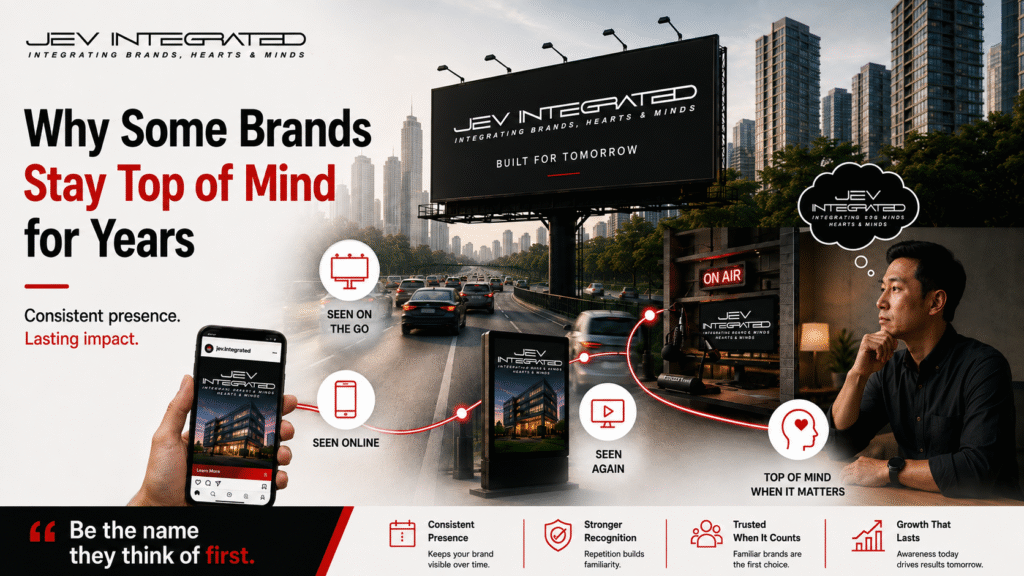
Long-term brand recognition usually comes from repeated encounters. A customer sees the brand during their commute, encounters it again online, hears about it through another medium and then sees a new campaign several months later that still feels familiar.
Each encounter strengthens something that already exists.
At JEV Integrated, this is why we don’t necessarily look at advertising as a series of isolated campaigns. When the business objective is long-term brand building, we can plan how different campaigns and media placements maintain enough continuity for the brand to stay present without simply repeating the same advertisement forever.
Staying Consistent Doesn’t Mean Staying the Same
There’s another challenge here. Brands need consistency, but nobody wants to see exactly the same creative for years.
The solution is to evolve the advertising without constantly resetting the brand.
A new campaign can introduce different products, promotions or creative ideas while maintaining recognisable elements such as visual identity, tone, positioning or a central brand message. Customers get something fresh, but they don’t have to figure out who is speaking to them all over again.
This becomes particularly important when multiple advertising channels are involved. OOH might need a simple visual message, DOOH can introduce movement and variation, digital content can go deeper, while radio or cinema communicates differently again.
JEV can help connect those executions so the medium changes without the brand becoming unrecognisable.
Your Competitors Don’t Disappear When Your Campaign Ends
This is something businesses sometimes overlook.
Imagine your company runs a strong three-month awareness campaign and then disappears from advertising for the rest of the year. During those nine months, competitors continue appearing in front of the same audience.
When customers finally enter the market, which brands feel familiar?
This doesn’t mean businesses need to spend heavily every month. It means advertising should be planned with continuity in mind.
At JEV Integrated, we can help clients decide where sustained presence matters and where campaign bursts make more sense. A long-term OOH placement may maintain everyday visibility, for example, while DOOH or digital activity increases around launches and important campaign periods. Another business may need a completely different combination.
The objective is to avoid spending simply to “stay active”. Every phase should still have a purpose.
More Exposure Isn’t Always the Solution
If a brand has been advertising consistently but still isn’t being remembered, increasing frequency isn’t automatically the answer. There could be a deeper issue with the media selection, creative, message or how different campaigns connect.
This is where JEV would look at the wider picture. Are we reaching the audience that actually matters? Does the creative make the brand easy to identify? Are campaigns reinforcing the same positioning? Are we appearing in locations and media environments that make sense for the audience? Is the budget being spread too thinly across too many channels?
Depending on what we find, the solution could be stronger media presence, better creative consistency, a different channel mix or simply a clearer message.
Because JEV Integrated works across media planning and buying, creative development, OOH, DOOH, digital, television, radio and cinema, we can approach brand visibility as one connected challenge rather than asking each advertising channel to solve it independently.
Becoming the Brand People Think of First
Top-of-mind awareness isn’t built by asking customers to remember you. It’s built by giving them enough relevant and consistent reasons not to forget you.
That requires patience. Some campaigns are designed to generate action today, while brand building creates value for customers who may not be ready until months or even years later. Businesses need both, and the balance depends on what they’re trying to achieve.
JEV Integrated helps brands find that balance by connecting the strategy, creative and media around a clear objective. Sometimes the priority is immediate response. Sometimes it’s sustained visibility. Often, the strongest approach allows short-term campaigns to generate action while long-term advertising continues building recognition in the background.
When the customer eventually needs your product or service, you don’t want that moment to be their first introduction to your business.
You want to be the name that was already there.
Frequently Asked Question
What is the minimum duration for a billboard campaign in Malaysia?
The standard minimum booking cycle for static billboards in Malaysia is 4 weeks (1 month). However, Digital Out-Of-Home (DOOH) screens allow shorter, highly targeted runs ranging from a few days to 2 weeks for flash events and time-sensitive launches.
Why is 3 months (12 weeks) recommended for most outdoor ad campaigns?
A 12-week campaign strikes an optimal balance between audience reach and brand recall. It provides sufficient frequency for daily commuters to transition from initial brand awareness to consideration and online search behavior.
How often should you change billboard artwork during a long campaign?
For long-term campaigns lasting 6 to 12 months, refreshing artwork every 2 to 3 months prevents ad fatigue while maintaining prime site presence along key commuting routes.